

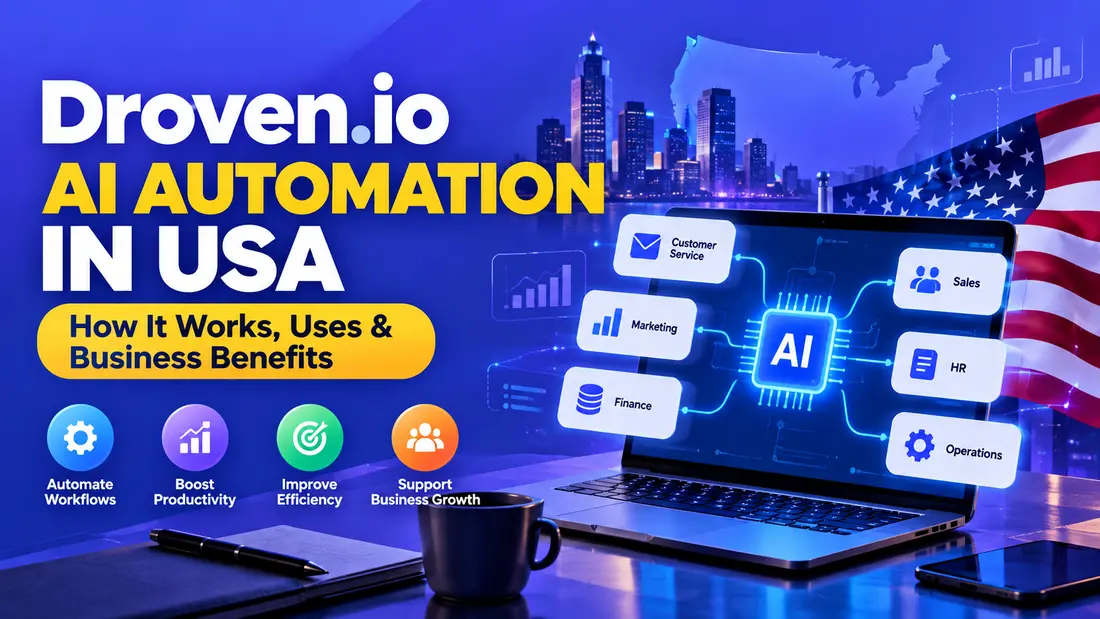
If you have searched for Droven.io AI automation in USA, you may be wondering whether Droven.io is an AI automation platform, a software tool, or simply a place to learn about AI and automation.
The answer is worth clearing up before going any further.
Based on the way its public website presents itself, Droven.io is mainly an editorial technology resource covering AI, automation, business technology, digital transformation, and related topics. It does not appear to be presented as a standalone AI automation SaaS platform where businesses can sign up, build workflows, and run AI agents.
That distinction matters.
If you are a business owner in the USA looking into AI automation, you need to know whether you are reading about a software product or learning from a technology publication.
So, let’s break down what Droven.io is, what AI automation means, how American businesses can use it, and what to check before bringing an AI system into your business.
What Is Droven.io?
Droven.io is a technology-focused website that covers topics related to artificial intelligence, business technology, digital transformation, software, and automation.
Its content covers areas such as AI tools, generative AI, business processes, marketing technology, analytics, IT, cybersecurity, workplace technology, and other technology topics.
For someone researching AI automation, this makes Droven.io useful as an informational resource.
Think of it this way.
You might visit a technology website because you want to understand how AI chatbots work. Another day, you may want to learn about AI marketing tools or automation in business. The same type of research can help you understand where AI fits into everyday business operations.
Is Droven.io an AI Automation Software Platform?
This is one of the most important questions to answer.
The available information does not establish Droven.io as a commercial AI automation platform. There is no clear evidence in the supplied material that it provides a subscription-based automation system, AI agents, or a workflow builder for businesses.
So, it would be inaccurate to describe Droven.io itself as software that automatically runs business processes.
Instead, it is better to view Droven.io as a technology information source that covers AI, automation, and business technology topics.
That simple distinction can save readers from expecting a product that may not actually be offered.
What Does AI Automation Mean?
AI automation combines regular workflow automation with artificial intelligence.
Traditional automation usually follows a fixed set of rules.
For example:
- When an invoice arrives, save it to a folder.
- When someone submits a contact form, send a confirmation email.
- When inventory drops below a certain number, alert the manager.
These workflows work well when the process is predictable.
AI automation can handle information that is less structured.
For example, an AI system can:
- Read and classify customer emails.
- Summarize meetings.
- Create follow-up tasks.
- Draft marketing content.
- Extract information from documents.
- Sort customer support requests.
- Help forecast demand.
- Assist developers with code and documentation.
The difference is simple. Traditional automation follows instructions. AI automation can also work with language, documents, patterns, and other forms of less structured information.
How AI Automation Is Used by Businesses in the USA
AI automation has applications across many parts of a business.
You do not need to automate an entire company to see value from it. In many cases, a single repetitive task can be a good starting point.
AI Automation for Customer Service
Customer support teams often deal with the same types of questions every day.
A customer may ask about an order, refund, delivery, account issue, or product.
AI automation can help classify incoming tickets, suggest responses, operate chatbots, and send requests to the right team.
For example, an AI system could recognize that one customer is asking about a refund while another wants an update on an order. Each request can then follow the correct workflow.
A human employee can step in when the request is sensitive or requires a decision.
AI Automation for Marketing
Marketing teams spend a lot of time working with data and repetitive content tasks.
AI automation can help with:
- Content briefs
- Lead segmentation
- Email campaigns
- Performance summaries
- Customer personalization
- Marketing data analysis
Instead of manually sorting every lead or preparing every report, marketers can use automation to handle the first stage of the process.
The team can then spend more time on strategy, creative work, and customer research.
AI Automation for Sales
Sales teams also have plenty of repetitive work.
After a sales call, someone may need to write notes, update the CRM, prepare a follow-up email, and organize the next action.
AI automation can assist with each of these tasks.
It can summarize calls, update customer records, score leads, and prepare follow-up drafts.
That does not mean the salesperson disappears from the process. The salesperson still decides what to send and how to handle the relationship.
AI Automation for Finance
Finance departments deal with large amounts of documents and data.
AI automation can help extract information from invoices, identify unusual transactions, reconcile documents, and prepare report drafts.
Imagine a company receiving hundreds of invoices every month.
Instead of having an employee manually enter every piece of information, an automated system can extract the basic details and send the results into the accounting workflow.
A person can then review the information before final approval.
AI Automation for HR
Human resources teams can use AI automation for administrative tasks.
Examples include:
- Employee feedback summaries
- Routine policy questions
- Onboarding workflows
- Document processing
- Internal information requests
HR is also an area where businesses need extra care.
Automated systems should not be allowed to make sensitive employment decisions without proper review and controls.
AI Automation for Operations
Operations teams often deal with inventory, scheduling, logistics, and demand planning.
AI automation can help monitor inventory, identify supply chain exceptions, forecast demand, and support routine scheduling.
For a growing company, even a small improvement in these workflows can reduce manual work.
AI Automation for IT and Security
IT teams receive large numbers of alerts, support requests, and technical issues.
AI automation can help sort alerts, summarize incidents, organize documentation, and identify repetitive support requests.
The goal is not to let AI make every technical decision.
The goal is to help the IT team get through repetitive work faster while keeping people involved when an issue needs deeper attention.
A Simple Example of AI Automation
Let’s say you run an online store in the USA.
Every day, your support inbox receives messages about:
- Delivery times
- Refunds
- Damaged products
- Address changes
- Product questions
Without automation, an employee may have to read every message, identify the issue, find the right information, and write a response.
With AI automation, the system can first identify what each customer needs.
A delivery question can go into one workflow.
A refund request can go into another.
A damaged-product complaint can be sent to a support employee.
A simple question may receive an AI-generated response based on approved company information.
But there is an important part here: not every decision should be automated.
A large refund, legal complaint, account-security issue, or sensitive customer situation may need human approval.
This type of setup lets AI handle routine work while people stay involved where judgment matters.
Benefits of AI Automation for U.S. Businesses
Why are businesses interested in AI automation?
The answer usually comes down to time and workload.
AI automation can help businesses:
- Reduce repetitive administrative work.
- Process large numbers of emails, documents, or support tickets.
- Respond to customers faster.
- Make business information easier to find.
- Keep routine workflows more consistent.
- Give employees more time for creative and relationship-based work.
- Turn business data into alerts, forecasts, and decision-support information.
For a small business, this can be especially useful.
A small team may not have the budget to hire several people for administrative tasks. Automating some of those tasks can help the existing team handle more work.
But the real value comes from choosing the right workflow.
Automating a bad process does not magically make it a good process.
Risks and Limitations of AI Automation
AI automation is not perfect.
It can produce incorrect information, misunderstand requests, expose sensitive data, or make poor decisions when it is given weak instructions or poor-quality information.
That is why businesses need controls around their AI systems.
Incorrect AI Outputs
AI systems can produce answers that sound confident but are wrong.
For this reason, important business information should be reviewed before it is used.
Data Privacy and Security
Businesses may process customer records, employee information, financial documents, passwords, contracts, or other private information.
Before connecting an AI tool to business systems, companies should understand how that data is stored and handled.
Bias and Sensitive Decisions
AI can create problems when used for areas such as hiring, employee screening, lending, insurance, or customer eligibility.
These decisions can have serious consequences, so businesses need appropriate human review and safeguards.
Access and Control
An automation system may be connected to email, databases, payment systems, CRM platforms, or other tools.
If permissions are too broad, an automation could perform actions that it should not be allowed to perform.
Businesses should also keep records that show what an automation did and when it did it.
These risks are why responsible AI management matters when businesses introduce AI into important workflows.
How to Choose an AI Automation Tool
If you are considering AI automation for your business, do not start by asking, “Which AI tool should I buy?”
Start with the business problem.
1. Define the Business Problem
Find one repetitive task that takes too much time.
It could be:
- Slow lead follow-up
- Manual CRM updates
- Repetitive customer questions
- Invoice processing
- Document organization
A clear problem gives you something measurable to improve.
2. Map the Existing Workflow
Before automating anything, understand how the current process works.
Who handles it?
Where does the information come from?
Which systems are involved?
Where does human approval happen?
Which steps could cause problems if something goes wrong?
Answering these questions gives you a clearer picture of what should and should not be automated.
3. Start With a Low-Risk Pilot
You do not need to automate your most important business process on day one.
Start small.
Meeting summaries, internal documents, content briefs, ticket classification, and draft responses can be easier places to test an AI workflow.
Once you understand how the system performs, you can decide whether to expand it.
4. Check Integrations
The best AI automation system is not useful if it cannot work with your existing tools.
Check whether it supports the systems your company already uses, such as:
- CRM software
- Email platforms
- Help desks
- Accounting systems
- Cloud storage
- E-commerce platforms
- Team collaboration tools
5. Review Privacy and Security
Ask where your data is stored.
Find out whether prompts or uploaded files are used for model training.
Check user permissions, access controls, data deletion options, and administrative settings.
These details may not be exciting, but they matter once AI becomes connected to real business information.
6. Keep Humans Involved
Some actions should have a human approval step.
This is especially important for financial transactions, employment decisions, legal matters, medical information, security incidents, and sensitive customer issues.
AI can prepare information or recommend an action. A person can make the final call.
7. Measure the Results
You need a way to know whether automation is actually helping.
Useful measurements can include:
- Time saved
- Error rate
- Customer satisfaction
- Conversion rate
- Ticket resolution time
- Number of human corrections
- Employee adoption
Without measurements, it is difficult to know whether an automation is worth keeping.
8. Document the Workflow
Keep a record of what the automation does.
Document its purpose, data inputs, owner, limitations, review schedule, and process for disabling it.
This makes the system easier to manage as the business grows.
Is Droven.io Legitimate and Useful?
Based on the supplied information, Droven.io presents itself as an editorial technology website with content covering AI, digital transformation, business processes, IT, analytics, and related technology topics.
For readers, that means it can be viewed as an informational resource for discovering AI and technology topics.
However, readers should not automatically treat an editorial website as a software vendor, independent product-testing organization, or professional consulting company.
If you discover an AI tool through an article, do your own checks before buying it.
Look at the vendor’s product information.
Test the software.
Review its security policies.
Check its integrations.
Calculate the total cost.
And, if sensitive business data is involved, understand exactly how that information will be handled.
That extra step can save a business from making a costly decision based only on an article or product description.
Droven.io AI Automation in USA: What Should Businesses Know?
The phrase Droven.io AI automation in USA can create some confusion because it sounds like the name of a specific AI automation product.
The available information paints a different picture.
Droven.io is presented primarily as an informational technology resource covering AI, automation, business technology, and digital transformation. It is not clearly established in the supplied material as an AI automation SaaS product.
The broader subject of AI automation is still highly relevant to U.S. businesses.
Companies can use AI automation for customer service, marketing, sales, finance, HR, operations, IT, and many other workflows.
The key is to start with a real business problem, test the automation on a manageable task, protect sensitive information, measure the results, and keep people involved when a decision carries serious consequences.
Frequently Asked Questions
What is Droven.io?
Droven.io is presented as a technology-focused editorial website covering AI, automation, digital transformation, business technology, IT, analytics, and related subjects.
Is Droven.io an AI automation platform?
The supplied information does not establish Droven.io as a standalone AI automation software platform. It is better described as an informational technology resource.
What is AI automation?
AI automation combines workflow automation with AI capabilities such as language processing, content generation, classification, summarization, document processing, and decision support.
How can U.S. businesses use AI automation?
Businesses can use AI automation for customer support, marketing, sales, finance, HR, operations, IT, document processing, and other repetitive workflows.
What are the benefits of AI automation?
Potential benefits include less repetitive work, faster responses, easier information processing, more consistent workflows, and more time for employees to focus on tasks that need human judgment.
What are the risks of AI automation?
Risks include incorrect outputs, privacy problems, security weaknesses, biased results, excessive system permissions, and poor decisions when human review is missing.
How should a business choose an AI automation tool?
Start with a specific business problem. Map the existing workflow, test a low-risk use case, check integrations, review privacy and security, measure results, and document the system.
Does AI automation replace human workers?
AI automation can reduce the amount of repetitive work people perform, but many workflows still need human review, especially when decisions involve money, employment, legal matters, security, medical information, or sensitive customers.
Is Droven.io useful for learning about AI automation?
Based on the supplied information, Droven.io can be used as an informational resource for AI, automation, business technology, and digital transformation topics. Readers should still verify software claims and product information independently before making a business purchase.
Final Thoughts
If you came across the term Droven.io AI automation in USA, the first thing to understand is what Droven.io actually represents.
The available information describes it as an editorial technology resource rather than a clearly defined AI automation software product.
The bigger topic, AI automation, is much broader.
For U.S. businesses, it can help with repetitive customer service tasks, marketing workflows, sales administration, document processing, finance operations, HR tasks, inventory management, IT support, and more.
The smartest way to approach automation is to keep it practical.
Find a real problem.
Start with a small workflow.
Test the results.
Protect business data.
Keep human approval where it matters.
And only expand the automation when it proves useful in the real world.
That approach turns AI from an interesting technology topic into a practical business tool.
Read Also: SEO Agency in USA Glorvix: Services, SEO Approach, and What Businesses Should Verify