

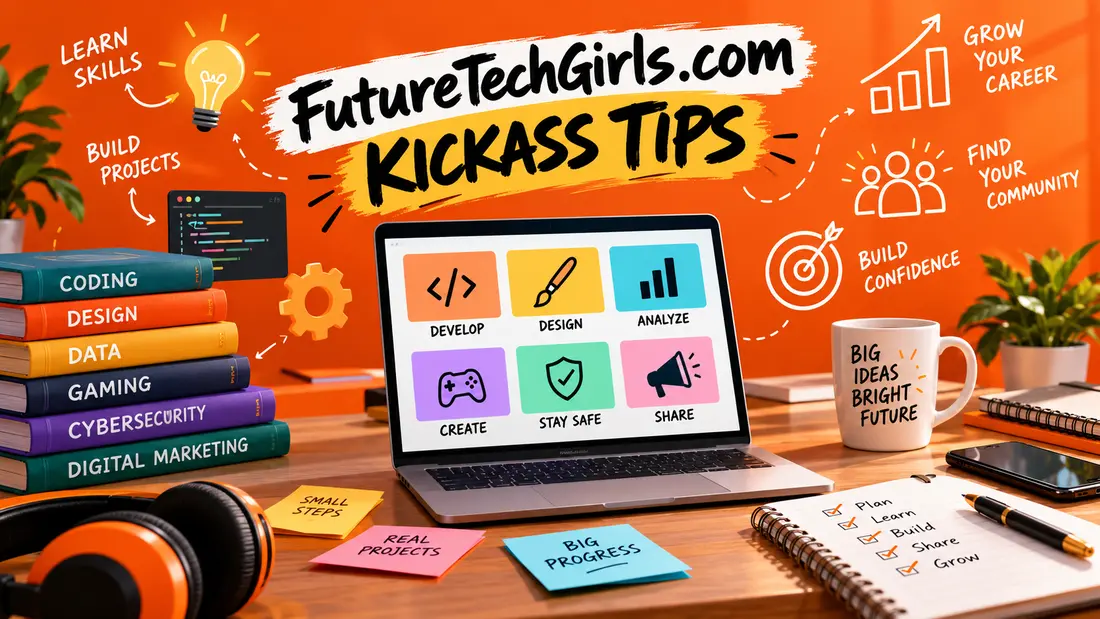
Getting started in technology can feel confusing.
There are so many paths to choose from. Web development, UX design, cybersecurity, gaming, data, AI, digital marketing, and plenty of other fields can all look interesting at the same time.
That can leave beginners wondering where to start.
The idea behind FutureTechGirls.com kickass tips is simple. You do not need to know everything before you begin. Pick a direction, learn through practice, build real projects, show your work, connect with people, and keep moving forward.
You may not feel ready at first. That is normal.
The goal is not to wait until you feel confident. The goal is to build confidence by doing the work.
What Are FutureTechGirls.com Kickass Tips?
FutureTechGirls covers topics around technology, gaming, social and digital culture, along with its Kickass Tips content.
When people search for futuretechgirls.com kickass tips, they are generally looking for practical advice around becoming more confident, capable, and visible in the technology space.
It is not about learning every technical skill at once.
Instead, the idea is to take small steps that add up over time.
You might start by learning web design. Someone else may begin with coding. Another person may be interested in gaming, cybersecurity, data, or digital marketing.
There is no single starting point that works for everyone.
What matters is finding something that interests you and turning that interest into action.
1. Choose One Tech Skill to Start With
Technology is a huge field.
If you try to learn coding, cybersecurity, UX design, data analytics, cloud computing, game development, and digital marketing at the same time, you can quickly end up overwhelmed.
Start with one area.
Think about what naturally catches your attention.
If you enjoy visual creativity, UX or web design could be a good starting point.
If you like solving problems with code, front-end development may interest you.
If numbers and patterns grab your attention, try data analytics.
If you love games, look into game development.
If you enjoy investigation and technology safety, cybersecurity could be worth exploring.
If writing and online business interest you, tech content or digital marketing may be a better fit.
You do not have to choose your lifelong career on day one.
You are simply choosing where to begin.
That makes the decision much easier.
2. Learn by Building Real Projects
One of the easiest traps for beginners is getting stuck in tutorial mode.
You watch one video.
Then another.
Then another.
Soon you have spent weeks learning but have very little to show for it.
Try something different.
Build.
After learning basic HTML and CSS, create a simple website. After learning the basics of data analytics, make a small dashboard. After learning design principles, redesign an app screen.
Your first project does not need to be impressive.
It could be:
- A personal portfolio
- A simple landing page
- A study planner
- A basic blog layout
- A gaming community website
- A small data dashboard
- A mobile app design concept
The point is not to create something perfect.
The point is to use what you have learned.
That is where things start to click.
You will make mistakes. You will search for answers. You will probably rebuild parts of the project more than once.
That is all part of learning.
A finished small project can teach you more than hours of passive watching.
3. Stop Treating Mistakes as Failure
Technology comes with errors.
Code breaks.
Designs need changes.
Projects get stuck.
Applications get rejected.
Sometimes you can spend an hour trying to fix something only to discover that the problem was caused by one tiny detail.
It happens.
Instead of treating mistakes as proof that you are not good at technology, use them as clues.
An error message tells you what needs attention.
A broken feature gives you a chance to practise debugging.
Feedback shows you what could be better.
A project that does not work as planned can teach you what to change next time.
Even rejection can give you useful information.
Maybe your portfolio needs more examples. Maybe you need to explain your skills more clearly. Maybe there is another skill worth developing.
You do not have to enjoy every mistake.
Just do not let one mistake convince you to stop.
4. Build a Portfolio That Shows What You Can Do
A résumé tells people what you say you can do.
A portfolio gives them something to look at.
That difference matters, especially when you are starting out and do not have years of professional experience.
Imagine two people applying for the same beginner role.
One says, “I know HTML and CSS.”
The other says, “I built a responsive study planner using HTML and CSS.”
The second person has something concrete to discuss.
Your portfolio does not need dozens of projects.
A few useful projects can be enough to show how you think and what you can create.
For every project, try to include:
- Project name
- Purpose of the project
- Tools you used
- Screenshots or a demo
- Problem you were trying to solve
- What you learned
- What you would improve next
If you work with code, GitHub can be useful for publishing projects and documenting your work.
And remember, your first portfolio does not have to be your final portfolio.
It should grow as your skills grow.
5. Find Your Tech Community
Learning alone can get tiring.
Having people around you who understand what you are trying to learn can make the process feel much easier.
Look for communities where you can ask questions, share projects, learn from others, and discover new opportunities.
You could try:
- Women in tech communities
- Local meetups
- University groups
- Online coding communities
- Discord communities
- Hackathons
- Open-source projects
- Mentorship groups
- Study partners
You do not necessarily need a formal mentor either.
A mentor could be someone you work with, a teacher, a senior professional, or even someone a little further ahead in the same learning path.
When asking for help, keep your questions focused.
Instead of saying, “Can you help me become better at coding?” try asking, “Could you look at this project and tell me one thing I should improve?”
That makes it easier for someone to give you useful feedback.
And do not underestimate peer support.
Sometimes having one person who says, “Keep going, I had the same problem,” is enough to get you back to work.
6. Learn How to Talk About Your Work
Being good at something is only part of the picture.
You also need to explain what you have done.
This becomes useful during job interviews, client calls, networking conversations, applications, and team projects.
Try answering these questions about every project:
What problem does it solve?
Who is it for?
What did you build?
Which tools did you use?
What was difficult?
What did you learn?
You do not need to use complicated technical language.
In fact, simple explanations are often easier to understand.
For example, instead of saying, “I developed a responsive front-end architecture,” you could say, “I built a website that works across phones, tablets, and computers.”
The second version tells people exactly what you did.
Practice explaining your work to a friend who does not work in technology.
If they understand your explanation, you are probably on the right track.
7. Build a Professional Online Presence
You do not have to become an influencer.
You do not need to post every day.
You do not even need a huge audience.
You simply need a place where people can see what you are working on.
You could share:
- A new project
- A before and after design
- A coding project
- A bug you fixed
- Notes from something you learned
- A useful technology tool
- A lesson from a project
- A short breakdown of how you solved a problem
Your online presence can grow naturally.
For example, imagine you spend two weeks building a small website.
Instead of simply keeping it on your computer, share a screenshot and explain what you learned while building it.
That single post gives people a reason to see your work.
Over time, these small updates can create a record of your progress.
You are not trying to look like an expert.
You are showing that you are learning, building, and taking your work seriously.
8. Create a Tech Learning Routine You Can Maintain
Technology changes quickly.
There will always be another tool, platform, programming language, framework, or trend to learn.
Trying to keep up with everything is exhausting.
You do not need to.
Choose a small group of skills that match your current goal and give them your attention.
A simple weekly routine could look like this:
- Two sessions for learning a core skill
- One session for building or improving a project
- One short session for documenting your work
- One short session for networking or community activity
- A weekly review of what you learned
You can adjust the routine around your schedule.
Even 30 minutes of focused work can be useful when you do it consistently.
The key is to make learning part of your normal week instead of treating it like something you will do when you have lots of free time.
A 30-Day FutureTechGirls Kickass Tips Action Plan
Want to turn these ideas into action?
Here is a simple 30-day plan.
Days 1 to 3: Pick Your Direction
Choose one technology area.
Do not spend three days comparing every possible career.
Pick one reasonable starting point and find a beginner-friendly learning resource.
Days 4 to 10: Learn the Basics
Spend around 30 to 60 minutes each day learning.
Take notes.
Try examples.
Do not worry about remembering everything.
The goal is to understand the basics well enough to start building.
Days 11 to 20: Build Something
Now put your knowledge to work.
Create a small project related to your chosen skill.
Keep the scope small.
A project you finish is more useful than a huge idea that never gets completed.
Days 21 to 24: Improve Your Project
Go back through your work.
Fix errors.
Clean things up.
Improve the design or functionality.
Write a short description explaining what you built and what you learned.
Days 25 to 27: Publish Your Work
Put your project somewhere people can see it.
This could be GitHub, a portfolio website, Behance, LinkedIn, or another platform that fits your type of work.
Publishing can feel uncomfortable at first.
Do it anyway.
Your work does not need to be perfect before someone else sees it.
Days 28 to 30: Get Feedback and Plan the Next Step
Join a community.
Share your project.
Ask someone for feedback.
Then decide what you want to build or learn next.
After 30 days, you may not be an expert.
That is not the point.
You will have a clearer direction, practical experience, and at least one finished project.
That is a real start.
Common Mistakes to Avoid When Starting in Tech
A few habits can slow beginners down.
Trying to Learn Everything
Technology offers endless options.
You do not need to learn all of them.
Choose one area and give yourself time to understand it.
Watching Tutorials Without Practising
Tutorials can teach you the basics, but practice turns that knowledge into skill.
Build something after you learn.
Waiting Until You Feel Ready
You may never feel completely ready.
Start with a small project and let the work teach you.
Hiding Your Work
Your early projects will not be perfect.
That is okay.
Sharing your progress can help you get feedback and meet people with similar interests.
Comparing Yourself With Experienced Professionals
Someone who has been coding for five years will naturally know more than someone who started five weeks ago.
Compare your current skills with your previous skills.
That is a much more useful measure.
Chasing Every New Trend
You do not need to learn every new tool that appears online.
Build a solid foundation first.
Ignoring Communication Skills
Technology jobs are not only about technical tasks.
You will often need to explain ideas, discuss problems, write documentation, work with teammates, or speak with clients.
Good communication makes your technical skills easier for others to understand.
FutureTechGirls.com Kickass Tips for Building a Tech Career
The biggest lesson is that progress comes from action.
Choose one direction.
Learn the basics.
Build something.
Make your work visible.
Talk to people.
Ask questions.
Learn from mistakes.
Then do it again.
You may start with a simple website and eventually move into web development. You might begin with a small design project and later discover that UX is the field you want to pursue.
Your first choice does not lock you into one career forever.
It simply gives you somewhere to start.
And that is often the hardest part.
Final Thoughts
The best part about starting in technology is that you do not need to have everything figured out.
You can learn as you go.
You can change direction.
You can build small projects while you learn.
You can ask for help.
You can make mistakes and try again.
The FutureTechGirls.com kickass tips approach comes down to a few simple habits: choose a direction, learn through practice, create proof of your skills, build connections, communicate your work, and keep improving.
Do not wait for the perfect moment to start.
Pick one skill.
Build one small thing.
Then see where it takes you.
Read Also: www.futuretechgirls.com: A Complete Guide to FutureTechGirls